
For decades, entrepreneurs dreamed of building companies that could one day be acquired by a large corporate. An acquisition meant success, wealth, and validation.
But over the last five years, a new debate has emerged in India’s startup ecosystem.
What really happens after a startup gets acquired?
Do large companies buy brands to grow them?
Or do they simply remove competition?
The answer is more complex than most people think.
Acquisition Doesn’t Always Mean the Brand Dies
Many founders fear that once a corporate acquires their company, the original vision disappears.
Sometimes that happens.
Sometimes the exact opposite happens.
The outcome depends on why the acquisition happened.
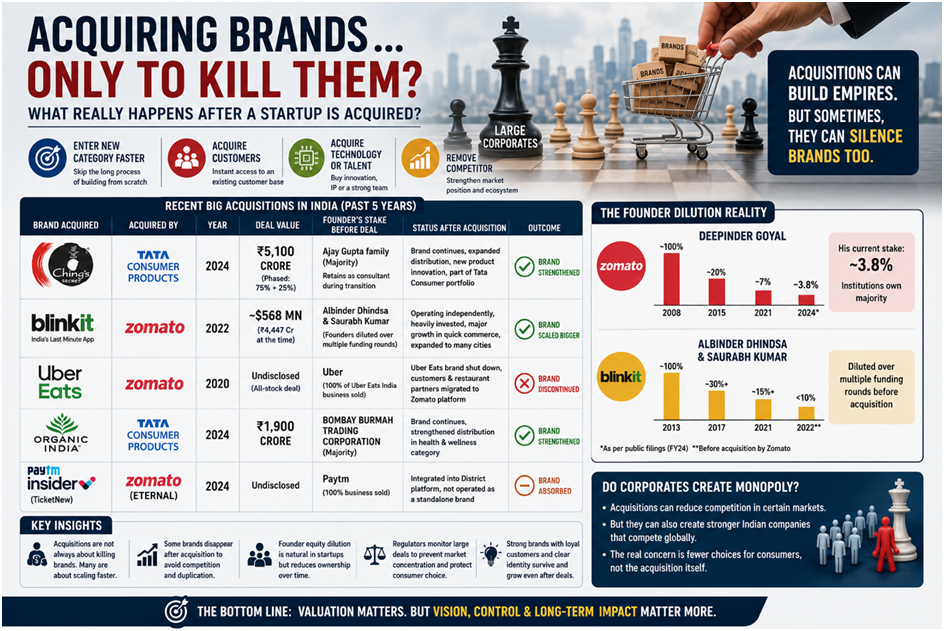
Generally, companies acquire brands for one of four reasons:
- To enter a new category faster.
- To acquire customers.
- To acquire technology or talent.
- To remove a competitor and strengthen their ecosystem.
Every acquisition has a different objective.
Case Study 1 – Ching’s Secret: Tata Consumer’s Biggest FMCG Bet
In 2024, Tata Consumer Products announced one of India’s biggest FMCG acquisitions by buying Capital Foods, the company behind Ching’s Secret and Smith & Jones, in a phased deal valued at approximately ₹5,100 crore. Tata also acquired Organic India for around ₹1,900 crore. The structure involved acquiring 75% upfront and the remaining 25% over the following three years. Founder Ajay Gupta stayed involved as a consultant during the transition.
Why?
Because building a national packaged-food brand from scratch takes years.
Buying one with existing consumer trust is much faster.
Instead of replacing Ching’s Secret with Tata’s own name, Tata chose to expand its portfolio and distribution through an already successful brand.
Lesson:
Sometimes corporates buy brands to accelerate growth—not eliminate them.
Case Study 2 – Blinkit: A Startup That Grew Bigger After Acquisition
In 2022, Zomato acquired Blinkit (formerly Grofers) in an all-stock deal worth about US$568 million (around ₹4,447 crore at the time). Blinkit continued to operate under its own brand and remained focused on quick commerce rather than being merged into Zomato’s food-delivery identity.
Today, Blinkit has become one of the biggest pillars of Eternal (formerly Zomato), expanding into many Indian cities while retaining its own brand identity.
This is an example where acquisition increased—not reduced—the brand’s visibility.
Case Study 3 – Uber Eats India
Not every acquisition keeps the acquired brand alive.
When Zomato acquired Uber Eats India in 2020, Uber Eats as a standalone consumer brand disappeared from the Indian market. Customers and restaurant partners were migrated to Zomato’s platform, and Uber received an equity stake in return. Industry observers expected the transaction to strengthen Zomato’s market position.
Here, the acquisition wasn’t about growing Uber Eats.
It was about consolidating the market.
The Founder Problem: Success Can Reduce Control
One of the biggest realities of startup funding is equity dilution.
Every time founders raise money, they usually issue new shares to investors.
This helps the company grow.
But it also reduces the founders’ ownership percentage.
Many founders start with nearly 100%.
After several funding rounds…
That ownership may fall dramatically.
For example, public disclosures show that Deepinder Goyal now owns only a small percentage of Eternal (formerly Zomato), while institutional investors collectively own much larger stakes. As of recent public filings, his holding is around 3.8%.
Does that mean he lost?
Absolutely not.
His percentage became smaller.
But the company’s total value became much larger.
Owning 3–4% of a multi-billion-dollar company can be worth far more than owning 100% of a small startup.
Is India Moving Towards Monopoly?
This is probably the most debated question.
The answer isn’t simply yes or no.
When one company acquires another, competition can decrease in that specific market.
However, acquisitions can also create stronger Indian companies capable of competing globally.
India’s competition laws require regulators to review many large transactions precisely because market concentration can affect consumers.
The concern isn’t acquisition itself.
The concern is whether consumers eventually have fewer choices.
What Every Startup Founder Should Learn
Many founders focus only on valuation.
But valuation is only one part of the story.
They should also ask:
- Who will control the company after funding?
- How much equity will remain with the founders?
- What happens if the company is acquired?
- Will the brand continue independently?
- Will the company’s culture survive?
Sometimes selling early creates enormous wealth.
Sometimes retaining greater control creates an even bigger business.
There is no universal answer.
The Future of Brand Acquisitions
Over the next decade, India will likely see even more acquisitions across FMCG, cosmetics, quick commerce, fintech, healthtech, SaaS, and D2C brands.
Large corporations are increasingly choosing to buy innovation rather than build everything internally.
For founders, this creates tremendous opportunities—but also important decisions about ownership, governance, and long-term vision.